

Life is full of crossroads. Some are small, like deciding how to spend an afternoon, and others are massive, like choosing a career path, a life partner, or whether to move across the country. In these moments of uncertainty, many believers turn to prayer, seeking guidance that goes beyond their own limited understanding. Prayer for God’s direction is not about handing over responsibility for our choices; it’s about inviting wisdom into the decision-making process so that we walk forward with confidence rather than fear. This article explores why guidance matters, how to pray for it, and what it looks like when God answers.
Why We Need God’s Guidance?
Human beings are remarkably good at overthinking. We can analyze a decision from every angle and still feel stuck, unsure if we’re choosing wisely or simply following our own desires. God’s guidance offers something different: a perspective rooted in truth rather than fear, ego, or temporary emotion. When we invite Him into our decision-making, we’re acknowledging that we don’t have to carry the full weight of every choice alone.
Seeking God’s Wisdom Every Day
Wisdom isn’t something we stumble into by accident. It’s cultivated through consistent conversation with God, a little bit each day rather than only in moments of crisis. When we make seeking His wisdom a daily habit, we train ourselves to recognize His voice more clearly when bigger decisions arrive. It becomes less about scrambling for an answer and more about staying tuned to a frequency we’ve already grown familiar with.
This daily seeking can look as simple as a few honest minutes each morning, asking God to order your thoughts and sharpen your discernment for the day ahead. Over time, this practice changes the way you process information and people around you. You start noticing details you might have missed, sensing caution where you once rushed forward, and feeling peace in decisions that once would have caused anxiety. That steady, unhurried wisdom is one of the quiet gifts of a consistent prayer life.
Morning Prayer for Direction

Mornings set the tone for everything that follows. Before the noise of emails, errands, and obligations takes over, there’s a small window where the mind is still quiet enough to genuinely listen. Praying for direction at the start of the day isn’t about asking God to hand you a step-by-step itinerary; it’s about positioning your heart to notice His leading as the day unfolds, in conversations, in opportunities, and in quiet nudges of conscience.
Asking God to Lead Your Steps
There’s an old, simple kind of prayer that goes something like this: “Lord, order my steps today. Let me see what You want me to see, and let me walk where You want me to walk.” It sounds basic, but that simplicity is exactly the point. Asking God to lead your steps means letting go of the pressure to have it all figured out before you even leave the house.
Practically, this kind of prayer changes how you move through the day. Instead of charging ahead on autopilot, you stay a little more alert to which doors open easily and which ones seem to resist you. You become more willing to pause before a hasty reply, more open to an unplanned conversation, more attentive to that quiet internal “wait” or “go.” Many people find that this small daily habit, repeated over weeks and months, gradually reshapes the entire direction of their life.
Prayer for Important Decisions
Some decisions carry more weight than others; a job offer, a major financial commitment, a relationship that’s reaching a turning point. These are the moments when prayer often becomes more intentional and specific. Rather than a passing thought, it becomes a deliberate pause: laying out the choice honestly before God, including the parts of the decision we’re afraid to admit, like pride, fear, or impatience clouding our judgment.
Trusting God’s Plan
Trusting God’s plan doesn’t mean pretending you have no opinion or preference. It means holding your preference loosely enough that you’re genuinely willing to be redirected if the answer turns out to be different from what you expected. This kind of trust is built, not instant; it grows stronger every time you look back and see how a closed door actually protected you from something you couldn’t see at the time.
When facing an important decision, it helps to write out both the practical pros and cons and your honest emotional reaction to each option, then bring that whole picture to God in prayer rather than just the surface-level facts. This kind of honesty makes the process less about manipulating an outcome and more about genuine partnership. Over time, many people report that trusting God’s plan, even in moments when it didn’t make immediate sense, became the foundation of a deeper, steadier kind of faith.
Prayer for Career and Future Guidance

Work and career take up an enormous portion of our waking hours, so it makes sense that so much anxiety clusters around questions like “Am I in the right job?” or “Should I take this risk?” Praying over career and future direction acknowledges that our work isn’t separate from our faith; it’s one of the primary places where our gifts, our character, and our daily choices intersect with the wider world.
Finding Purpose Through Faith
Purpose rarely arrives as a single dramatic revelation. More often, it’s discovered gradually, through paying attention to what energizes you, what kind of work leaves you feeling used for something meaningful rather than just drained. Faith adds a layer to this search by reminding us that our skills and passions weren’t placed in us randomly; they’re part of a larger design meant to serve something beyond our own comfort or status.
Practically speaking, finding purpose through faith might mean praying specifically over your strengths and asking God to show you where they could be used to help others, not just to advance your own goals. It can also mean staying patient through seasons that feel directionless, trusting that even unglamorous jobs or unexpected detours are shaping you for what’s ahead. Many people look back on a confusing chapter of their career and realize, only in hindsight, exactly how it prepared them for the next one.
Prayer for Guidance in Relationships
Relationships, whether romantic, familial, or friendships, are some of the most complex parts of life to navigate well. They involve another person’s free will, their own struggles, and a constantly shifting dynamic that no amount of planning can fully control. Praying for guidance here means asking for discernment about who to trust, how to communicate with grace, and when to set healthy boundaries.
Building God-Centered Relationships
A God-centered relationship is one where both people are oriented toward something bigger than just their own immediate wants. It doesn’t mean perfection or the absence of conflict; it means a shared commitment to honesty, humility, and grace when things get hard. Praying together, or at least praying individually for the relationship, helps keep that center of gravity intact even during difficult seasons.
In practice, this might look like asking God for patience before a hard conversation, or praying for the wisdom to apologize first even when you feel you’re not entirely at fault. It also means being willing to ask God to reveal blind spots in your own behavior rather than only focusing on what the other person needs to change. Relationships built this way tend to weather storms more steadily, not because they avoid conflict, but because both people keep returning to the same anchor.
Bible Verses About God’s Direction
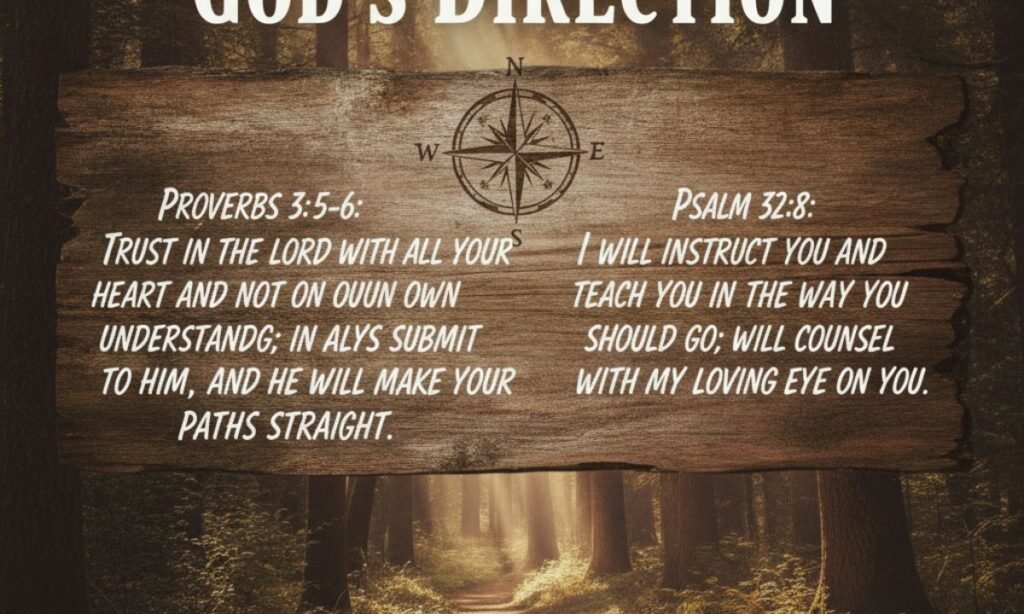
Scripture has shaped how believers think about guidance for thousands of years, offering language and imagery that prayer alone sometimes struggles to capture. Returning to these verses regularly, not just reading them once, helps reframe uncertainty as an invitation to trust rather than simply a problem to solve on your own.
Scriptures on Wisdom and Guidance
Proverbs 3:5-6 is one of the most quoted passages on this topic, encouraging believers to trust in the Lord with all their heart rather than leaning entirely on their own understanding. Verses like this remind us that human reasoning, while valuable, has limits, and that genuine direction often requires a willingness to submit our plans rather than insist on controlling every outcome ourselves.
Other passages, like James 1:5, speak directly to asking God for wisdom when we feel we lack it, with the promise that this wisdom will be given generously. Psalm 32:8 offers a tender image of God instructing and teaching in the way we should go, almost like a parent gently guiding a child’s steps. Keeping a short list of these verses somewhere visible, a notebook, a phone note, a sticky note on a mirror, can serve as a quick anchor point whenever doubt creeps back in.
Signs That God Is Leading You
One of the most common questions believers ask is simply: how do I know this is actually God, and not just my own wishful thinking? There’s no single formula, but there are patterns many people recognize over time, a sense of peace that doesn’t match the circumstances, doors that open with unusual ease, or a persistent inner conviction that doesn’t fade even after careful, honest scrutiny.
Recognizing God’s Voice
God’s leading rarely shows up as an audible voice; it tends to be quieter, often described as a settled sense of peace or a thought that keeps returning gently rather than urgently. It frequently aligns with what Scripture already teaches, which is why staying familiar with biblical principles makes it easier to recognize when an idea is consistent with God’s character versus when it’s simply emotional impulse dressed up as conviction.
Recognizing this voice gets easier with practice, much like learning to distinguish a familiar friend’s voice in a crowded room. It helps to journal moments when you sensed direction and later check whether that sense proved trustworthy, building a kind of personal track record over time. It also helps to seek wise counsel from trusted mentors or community, since genuine guidance rarely contradicts the input of people who know you well and have your best interests at heart.
How to Wait for God’s Timing
Waiting is, for most people, the hardest part of the entire process. We want answers quickly, and silence can feel like absence even when it isn’t. Learning to wait well doesn’t mean passively doing nothing; it means staying faithful and active in the present while resisting the urge to force an outcome before it’s ready.
Learning Patience Through Prayer
Patience isn’t a personality trait some people are simply born with; it’s a skill shaped through repeated practice, often in exactly the situations we’d rather avoid. Prayer during a season of waiting shifts the focus away from “when will this happen” and toward “how can I grow while I wait,” which changes the entire emotional texture of the experience.
One practical approach is to set aside specific prayer time dedicated only to the waiting season, naming the frustration honestly rather than suppressing it, and then asking for the strength to remain faithful in small daily responsibilities in the meantime. Many people find that the waiting period itself becomes some of the most formative time of their life, teaching lessons about character and trust that a faster answer never could have taught. Looking back, what once felt like delay often turns out to have been necessary preparation.
A Short Prayer for Wisdom and Direction
Sometimes what’s needed isn’t a long, elaborate prayer, but a short, honest one that can be repeated throughout a busy day. These brief prayers act like spiritual checkpoints, quick resets that keep your heart oriented correctly even when you don’t have time for an extended quiet moment.
Asking God for Clarity
A short prayer for clarity might be as simple as: “Lord, show me what I cannot see on my own, and give me the courage to follow it.” The brevity isn’t a lack of seriousness; it’s designed for real-life moments, sitting in traffic, waiting for a meeting to start, lying awake at 2 a.m., when a longer prayer simply isn’t practical.
These short prayers work best when they’re specific rather than vague, naming the exact decision or confusion you’re facing rather than offering a generic request. Repeating a short prayer like this consistently over several days, especially during a particularly confusing season, often brings a gradual clearing of thought, less like a sudden lightning bolt and more like fog slowly lifting off a familiar road.
Final Prayer for God’s Guidance
Every prayer for direction eventually arrives at the same essential posture: surrender. Not surrender in the sense of giving up, but surrender in the sense of loosening our grip on outcomes we were never fully meant to control in the first place. This final letting go is often the hardest and most freeing part of the entire process.
Surrendering Your Plans to the Lord
Surrendering your plans doesn’t mean abandoning ambition or stopping all forward movement; it means holding your plans with open hands rather than a clenched fist. It’s the difference between saying “this is what I will do no matter what” and “this is what I hope to do, but I trust there’s a better path if this isn’t it.”
A closing prayer of surrender might sound like: “Lord, these are my plans, but I lay them before You. Redirect me where I’ve gotten it wrong, and give me peace to follow wherever You lead.” Ending each season of decision-making with this kind of prayer creates a rhythm of release, allowing you to move forward with conviction while still remaining flexible enough to be redirected when life takes an unexpected turn.
Frequently Asked Questions
What is the best prayer to ask God for direction in life?
There’s no single “correct” prayer, but many people find that simple, honest requests work best, asking God to order their steps, reveal blind spots, and grant peace about the right path. The key is consistency and sincerity rather than finding perfectly worded language.
How do I know if God is answering my prayer for guidance?
Common signs include a growing sense of peace, doors opening naturally without excessive force, and guidance that aligns with biblical wisdom and the counsel of trusted, faith-filled people in your life. Confirmation often builds gradually rather than arriving all at once.
What Bible verse is best for guidance and direction?
Proverbs 3:5-6 is one of the most commonly referenced verses, encouraging trust in God rather than relying solely on personal understanding. Psalm 32:8 and James 1:5 are also frequently used for prayers focused on wisdom and direction.
How long should I wait for God to answer a prayer for guidance?
There’s no fixed timeline, and waiting periods vary significantly from person to person and situation to situation. Staying faithful in daily responsibilities and continuing to pray during the wait is often more important than the length of time itself.
Can I pray for guidance about small, everyday decisions, not just big ones?
Absolutely. Praying over small decisions builds the habit and sensitivity needed to recognize guidance more clearly when bigger decisions arise, making it a valuable practice regardless of how significant the decision feels.
Conclusion
Seeking God’s guidance is less about receiving a flawless roadmap and more about cultivating a posture of trust, patience, and daily attentiveness. Whether you’re facing a major life decision or simply trying to navigate an ordinary Tuesday with a little more peace, prayer offers a steady anchor in the uncertainty.
By making guidance a daily habit rather than an emergency request, leaning on Scripture, and learning to surrender your plans without losing your sense of purpose, you create space for a wisdom that goes far beyond your own. Direction may not always arrive quickly, but it tends to arrive faithfully, one step, one prayer, at a time.

I believe life becomes more beautiful when it is filled with blessings and positive words. For the past four years, I have been sharing simple but meaningful blessings that bring peace, hope, and joy to people’s lives.